Reading Guide:
Understanding Google Sans
Google Sans is a contemporary sans-serif typeface developed by Google for its visual identity. While many recognize it from Google’s logo and products like Gmail, Docs, and Calendar, it represents far more than branding.
Designed specifically for digital environments, Google Sans combines clarity, flexibility, and consistency in a way that feels equally at home in user interfaces, editorial layouts, and long-form articles. Its restrained personality allows the content—not the typography—to remain the focus.
Before explaining why I chose Google Sans as the foundation of Suede, it’s worth understanding what makes the typeface distinctive.
A brief history
Google Sans emerged from Google’s effort to create a unified typographic system across its growing ecosystem of products. Rather than relying on an existing commercial typeface, Google developed a family that could reflect its design language while meeting the demands of modern digital interfaces.
The typeface became widely recognizable with Google’s refreshed visual identity, but it has continued to evolve beyond the company’s logo. Today, it appears throughout Google’s products and services, creating consistency across a wide range of experiences.
Design philosophy
Google Sans balances precision with approachability. It feels contemporary without being trendy, geometric without becoming rigid, and expressive without distracting from the content it presents.
Rather than drawing attention to itself, the typeface is designed to support reading. Its proportions, spacing, and rhythm create a calm, familiar user experience that adapts naturally across headings, interfaces, and body text.
Readability on the web
Typography has one primary responsibility: helping people understand what they’re reading, with clarity and without distraction.
Google Sans performs exceptionally well on screens because it was designed with digital reading in mind. Open letterforms, comfortable spacing, and balanced proportions contribute to a reading experience that feels effortless across a wide range of devices and text sizes.
Those qualities become even more important in long-form publishing, where subtle typographic decisions can influence how comfortably readers engage with an idea over time, from the opening sentence to the final paragraph.
Variable font capabilities
One of Google Sans’s greatest strengths is its availability as a variable font. Instead of relying on separate font files for every style, a single variable font provides continuous control across multiple design axes.
For Google Sans, those include weight, width, and rounded styles, making it flexible while preserving a consistent visual voice. In practice, Suede primarily relies on the weight axis to create hierarchy throughout the system.
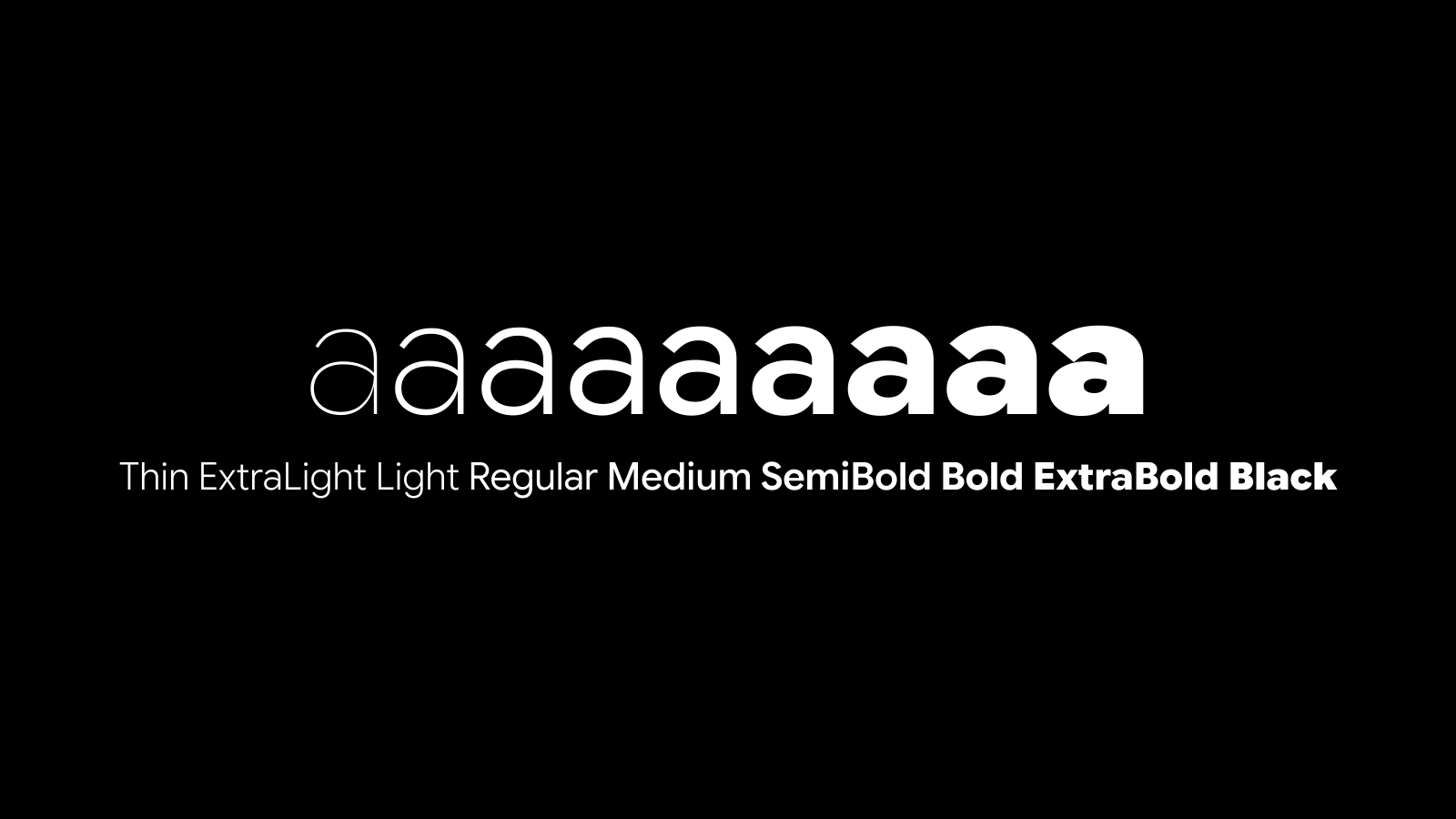
These capabilities allow designers to create hierarchy and emphasis without introducing additional typefaces. Rather than switching fonts to create contrast, Google Sans offers a typographic system within a single family.
See the official Google Sans specimen for the full range of styles.
Design characteristics
Google Sans isn’t memorable because of any single feature. It’s memorable because dozens of thoughtful design decisions work together.
Its proportions feel generous without becoming loose. Its rhythm remains even across different sizes and weights. And its overall personality is confident without feeling cold or overly expressive.
Those qualities make Google Sans particularly well-suited to editorial experiences, where typography should quietly support understanding rather than competing for attention.
Typography in editorial design
Typography is often treated as a visual decision, but its greatest influence is editorial. Before readers absorb a single idea, they experience the typography that presents it. Every choice—from size and weight to spacing and hierarchy—shapes how comfortably information can be understood.
Good typography doesn’t compete with the content. It reduces friction, establishes rhythm, and creates a reading experience that feels effortless. The best typography is often the typography readers never notice.
Perspective
Great typography lets good ideas take center stage.
Many websites combine multiple typefaces to create visual variety. I’ve increasingly come to believe the opposite approach is stronger.
One thoughtfully designed typeface with a broad range of capabilities can provide all the hierarchy and flexibility most editorial experiences require, while creating a more cohesive visual language.
That philosophy extends beyond typography itself. Design isn’t simply about making information attractive—it’s about making information easier to navigate. When typography supports the content instead of distracting from it, readers are free to focus on the ideas rather than the design.
Why I chose Google Sans
Every design system begins with a handful of foundational decisions.
For Suede, typography was one of the first. After exploring countless types over the years, I kept returning to Google Sans—not because it was familiar, but because it aligned with the reading experience I wanted to create.
Terminology
Throughout this article, I’ve referred to the typeface as Google Sans. Suede is built on Google Sans Flex, the variable version of the family that fine-tunes weight and width while maintaining a consistent voice.
What ultimately drew me to Google Sans wasn’t any single feature, but its balance. Contemporary yet refined, the font remains flexible enough to accommodate both interfaces and long-form editorial content.
One thoughtfully designed type family simplifies every decision that follows. Hierarchy comes from weight. Personality comes from composition. Every typographic decision speaks with the same, consistent voice.
That philosophy extends naturally into Suede. I believe good design should make ideas easier to understand, not simply more attractive to look at. Typography establishes the foundation, while Editorial Patterns provide structure, hierarchy, and orientation throughout the reading experience.
Google Sans wasn’t the only typeface I considered. It was simply the one that best reflected the values I wanted Suede to embody: clarity, consistency, restraint, and a quiet confidence that allows the content to remain the focus.
If I were starting Suede again today, I’d make the same decision.